API and Reseller SMM Panels in India: How They Actually Work
API and Reseller SMM Panels in India: How They Actually Work
Updated: 24 July 2026 · By the FastGrow team
Search for a reseller panel and you will find two terms used loosely and often interchangeably: API panel and child panel. They are related but not the same, and the difference decides how much work you take on and how much control you keep. Most people set one up expecting passive income and discover a customer-service business instead. This is the mechanics of how these actually work, and the honest picture of what running one involves.
What a reseller setup actually is
At the bottom of this whole industry sits a small number of large suppliers who fulfil orders through networks of accounts. Almost everything else, including most panels you have heard of, is a reseller of a reseller of one of those. When you resell, you buy services at one rate and sell them onward at a higher one, and your profit is the gap. The two common ways to do that are through an API connection or through a child panel.
API panel: you build the front, the supplier fulfils the back
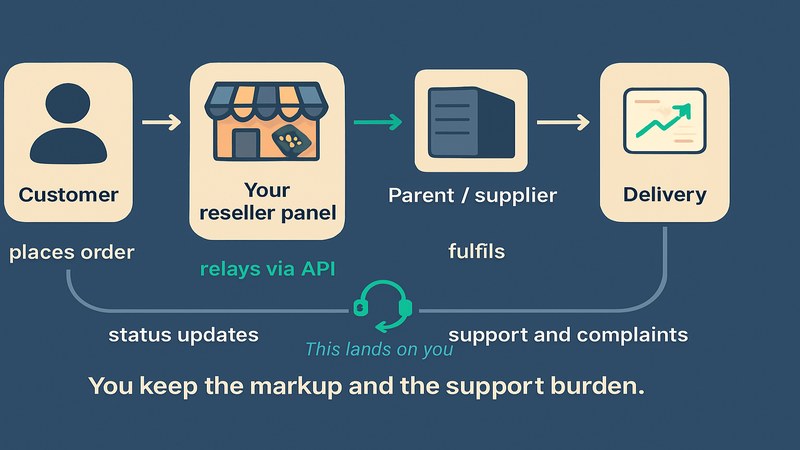
An API connection lets your own website place orders on a supplier automatically. A customer orders on your site, your site sends that order to the supplier through the API using a key the supplier gives you, the supplier fulfils it, and status updates flow back to your customer. You control the storefront, the branding and the prices; the supplier controls fulfilment.
This suits someone who already has a site or the ability to build one, and who wants their own brand rather than a clone. It is more setup than a child panel, and it means you handle your own hosting, payments and support. The upside is independence: your panel is genuinely yours, and you are not locked into one provider's template.
Child panel: a ready-made clone on someone else's system
A child panel is a pre-built panel you rent from a larger panel, usually on your own domain, that draws its services and fulfilment straight from the parent. You get a working storefront quickly, without building anything, and you set your own retail prices above the parent's rates.
The trade-off is control. You are on the parent's platform, using their template, dependent on their uptime and their service list, and if the parent has problems your child panel has the same problems. It is the fastest way to start and the least independent way to run, which is the right choice for someone testing the water and the wrong one for someone building something lasting.
Where the margin really is, and is not
The pitch is easy money on the markup. The reality is thinner, for a specific reason. The rates you buy at are low, but they are also close to public, and your customers can often find similar rates themselves with one search. That caps how much you can add. You are not selling secret access; you are selling convenience, trust and service on top of a commodity anyone can price-check.
So the resellers who do well are not the ones with the biggest markup. They are the ones who already have customers, a local network, an audience, a niche they are known in, who would rather deal with a person they trust than gamble on an anonymous foreign site. Distribution is the asset. The panel is just the supply behind it, a point we made in our wider look at how SMM reselling works in India.
The support burden nobody mentions
Here is what turns this from passive income into a job. When an order drops, delivers slowly or fails, the customer contacts you, not the supplier. Every complaint, every refund request, every confused first-timer is yours to handle. Your reputation rests entirely on a fulfilment layer you do not control, so when the parent or supplier has a bad day, you absorb the customer anger for it.
This is why choosing a reliable parent or supplier matters more than squeezing the lowest rate. A provider with steady delivery, real refill terms and responsive support means fewer fires for you to put out. A cheap, flaky one means your customers leave and blame you. The rate you buy at is far less important than whether it works every time.
How the options compare
| Setup | Speed to start | Control and branding | Best for |
|---|---|---|---|
| Child panel | Fastest, rented and ready | Low, on the parent's system | Testing the idea cheaply |
| API on your own site | Slower, needs a site | High, your brand and prices | Building something lasting |
| Manual reselling | Immediate, no tech | Full, but no automation | A small existing network |
| Direct supplier | Varies | Highest, but higher minimums | Established, high volume |
Live rates, API access details and reseller options are on the FastGrow services page rather than in this post, since these change.
Testing a provider before you build on it
- Place the smallest manual order first, exactly as you would vet any supplier, before wiring anything to an API.
- Ask support a real question and time the reply, since your customers' problems become your support tickets to them.
- Check refill and refund terms in writing, because you inherit them for every customer.
- Confirm the API or child-panel documentation exists and is clear before committing a domain to it.
- Keep your balance close to near-term needs rather than loading up for a discount on an unproven parent.
What a reseller setup cannot do
It cannot create customers, which is the hard part and the part no panel supplies. It cannot make a commodity service exclusive, so it will not support a large markup on its own. It cannot remove the support burden, which is the actual job. And it cannot protect you from a weak parent or supplier, whose failures land on your reputation.
Four steps to start sensibly
- Be honest about whether you have customers or a network. If not, solve that before building a panel.
- Start with a child panel to test cheaply, or an API on your own site if you are committing seriously.
- Vet the parent or supplier on delivery, support and refill terms before you rely on it.
- Price on the convenience and trust you add, not on a markup your customers can price-check away.
Questions people ask about API and reseller SMM panels in India
What is the difference between an API panel and a child panel?
An API panel connects your own website to a supplier so orders are placed automatically, giving you full branding and control. A child panel is a ready-made clone you rent from a parent panel, faster to start but running on the parent's system with less control.
What is a child panel?
A child panel is a pre-built SMM panel rented from a larger parent panel, usually on your own domain, that draws its services and fulfilment directly from the parent. You set retail prices above the parent's rates and keep the difference.
How does an SMM panel API work?
An SMM panel API lets your website send orders to a supplier automatically using an API key. A customer orders on your site, your site relays it to the supplier, the supplier fulfils it, and status updates return to your customer.
Is running an SMM reseller panel profitable in India?
An SMM reseller panel can be modestly profitable in India, but margins are thin because wholesale rates are close to public and customers can price-check them. Success depends far more on having a customer base than on the markup.
Do I need my own website to resell SMM services?
You need your own website for an API panel, but not for a child panel, which comes ready-built on a rented domain, or for manual reselling, which needs no technology at all. The right choice depends on how independent you want to be.
Who handles support when a reseller order fails?
The reseller handles all customer support, since the customer buys from you rather than the supplier. Every drop, delay or refund request comes to you, which is why reselling is a customer-service business rather than passive income.
How much does it cost to start a reseller panel in India?
Reseller and child-panel costs in India vary by parent and shift with supply conditions, so fixed figures go stale quickly. A child panel is typically the cheapest entry. Current FastGrow reseller options are on the FastGrow services page.
Is FastGrow legit for resellers?
FastGrow is an Indian SMM panel offering social media services with support available around the clock. Because every panel makes similar claims, the sensible test for a reseller is a small manual order and a support query before wiring an API or committing a domain.
What is a master panel?
A master panel is a term for a larger panel that other panels resell from, sitting above child panels in the chain. Most panels are resellers of a small number of large suppliers at the base of the industry.
Can customers find my supplier's rates themselves?
Customers often can find similar wholesale rates themselves, because SMM pricing is close to public. This caps reseller markups and means you compete on convenience, trust and service rather than exclusive access.
What matters most when choosing a parent panel?
Reliability matters most when choosing a parent panel, since its delivery, refill terms and support directly become your customers' experience. A cheap but flaky parent damages your reputation, because customers blame you, not the supplier.
Should I start with a child panel or an API panel?
Start with a child panel to test the idea cheaply, and move to an API panel on your own site if you are building something lasting and want your own brand. Both depend on a reliable parent or supplier behind them.
Where to go next
If you already have customers or a network and want to test reselling, reseller and API options are on the FastGrow homepage. If you are still weighing whether reselling suits you, our honest look at how SMM reselling works in India covers the business side, and the FastGrow blog has the rest. Solve customers first, then choose the setup.